

The work people see begins with the work they don’t.
Brand Runner brings you creative productivity frameworks, brand strategy, and timeless principles for building sharper systems, stronger ideas, and calmer execution.
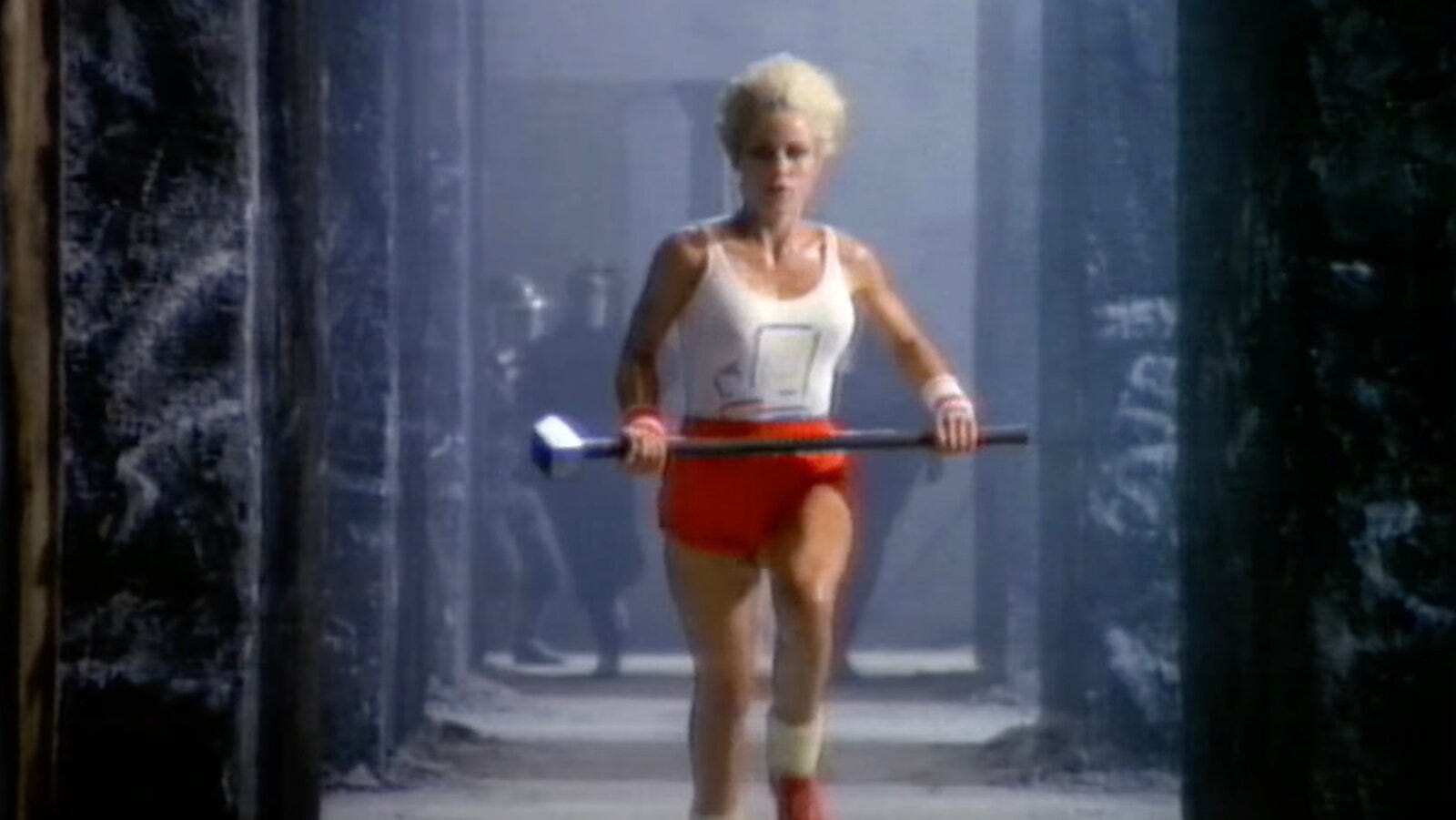
Epic Games parodied Apple’s “1984” in 2020. The fact that a 36-year-old ad is still instantly recognizable isn’t luck, it’s proof that some work transcends its media buy and becomes culture.
Most advertising dies the moment the campaign ends. A handful of spots refuse to leave. They lodge in the collective consciousness, get referenced, parodied, and claimed by audiences who weren’t even born when they first aired.
What separates memorable from forgettable? According to Ad Age’s deep dive on iconic advertising, it’s not budget, celebrity endorsements, or even Super Bowl placement. It’s craft, timing, and emotional resonance, plus the willingness to let audiences own your idea.
Let’s break down what actually works.
The Neuroscience of Memory: Why Stories Beat Facts
Your brain is constantly filtering noise. It has to be. You’re bombarded with visual, auditory, and tactile stimuli every second, and most of it gets discarded immediately.
“You probably remember the first time you rode a bicycle, but you don’t remember what you had for breakfast yesterday,” says Shahram Heshmat, associate professor emeritus at the University of Illinois at Springfield. “But if someone tells us a story, we remember it so well. If somebody just gives us facts, we don’t really.”
Stories create narrative structure. Life cereal’s “Mikey” was onscreen for just 30 seconds in the 1972 commercial. But everyone knows a picky kid who won’t eat anything, and the joy of watching them be wrong. That’s a story, not a product claim.
Emotion works like a laser.
Fear, joy, surprise.
They all trigger the amygdala, which doesn’t distinguish between good and bad feelings. During stress, epinephrine and cortisol consolidate memories. During pleasure, serotonin and dopamine do the same thing. Your body imprints emotional experiences because, evolutionarily, they signal survival-relevant information.
This is why Lyndon Johnson’s 1964 “Daisy” ad still haunts. It raised the specter of nuclear war with a little girl counting flower petals before a mushroom cloud. Pure fear. Impossible to forget.
Context overrides content. Most people over 25 remember where they were on 9/11, even if their immediate surroundings were mundane. The stakes elevated everything.
The Super Bowl leverages this biology. Adrenaline, attention, amygdalas aflame. There’s no better time to catch an audience desperately searching for a storyline. This is why Apple buried the original “1984” broadcast at midnight on New Year’s Eve in southern Idaho—so virtually no one saw it before the Super Bowl, guaranteeing maximum impact during the third quarter of Super Bowl XVIII.
Craft Decisions That Create Stickiness
In 1993, California’s milk industry faced a problem. “Milk, It Does a Body Good” wasn’t working. Health benefit claims were disprovable, and milk sales kept declining.
Goodby Silverstein & Partners flipped the strategy. Instead of talking about what milk does for you, they focused on what happens when it runs out.
“Milk is not the most important thing in your life, and ‘Got Milk?’ acknowledged that,” says Jeff Goodby, co-founder of the agency. “It’s really just a commodity. The only question is, do you have any of it or not?”
The inaugural spot featured a history buff surrounded by Alexander Hamilton memorabilia, mouth full of peanut butter sandwich, unable to answer a radio trivia question worth $10,000 because he’s out of milk. Absurd mythology, not rational claims.
Michael Bay directed it. Because of course he did. Bay’s maximalism—the odd living situation, the oxidized bedframe, the tchotchkes—created multiple memory hooks. More visual elements mean more ways to recall the spot.
Even the typography mattered. Instead of Helvetica, Rich Silverstein commissioned a custom typeface. Voiceover artist Denny Delk delivered the tagline with attitude, “like John Wayne,” according to Goodby. Every detail was designed for stickiness.
Subsequent spots doubled down on hyperbole. A dead jerk discovers he’s been sent to a milk-less hell. A paranormal child predicts catastrophe at a birthday party. Over-the-top worked because it was memorable, not because it was true.
Cultural Timing and Interpretation Space
Apple’s “1984” worked on multiple levels simultaneously, each speaking to a different segment’s discontent.
George Orwell’s novel was experiencing a resurgence in its eponymous year. Ridley Scott, already famous for “Blade Runner” and “Alien,” brought dystopian credibility. The aesthetic—totalitarian grays, surveillance screens, Big Brother—was instantly recognizable.
But the genius was the interpretation of space.
Conservatives worried that the Soviet Union saw anti-communist messaging. Liberals caught in the Reagan Revolution saw parallels to their own government. Techies chafing at IBM’s stranglehold identified with the scrappy upstart. The ad didn’t tell you what to think. It created room for you to find yourself in the story.
“Like a Girl” did the same thing in 2014, four years before #MeToo exploded back onto the scene. “It was the perfect storm of a change in the audiences and the type of communications that women in particular expected at that time,” says AJ Hassan, who was creative director on the Always campaign at Leo Burnett.
The spot revealed unconscious bias hiding in plain sight. “It was the emotion of something that was an unconscious bias that we were all participating in, right under our nose, being revealed to us.”
Great ads don’t create culture. They channel what’s already bubbling up and give people permission to name it.
The Ownership Effect: When Audiences Claim Your Idea
“Got Milk?” spawned hundreds, if not thousands, of parodies. School bake sales, local fundraisers, amateur spoofs. Goodby recommended the client get a lawyer to stop them. The client, Jeff Manning, said, “I can’t afford one, just let them do it.” That turned out to be brilliant.
When audiences feel ownership over an ad, campaigns transcend their media buy. McGruff the Crime Dog and Smokey Bear work because they feel public, not branded. “This Is Your Brain on Drugs” and “Friends Don’t Let Friends” became memes before the internet existed.
“Because it’s not tied to a brand, they can feel like they own it,” says Lisa Sherman, CEO of the Ad Council. “It is theirs and therefore it gives them more permission to tweak and iterate with us over time.” Letting people steal your idea is smarter than protecting it.
What This Means for You (Five Rings Application)
🪨 Earth Ring: Craft compounds. Custom typeface, voice attitude, visual language—these aren’t decorative choices. They’re memory infrastructure that makes everything else stick.
🌊 Water Ring: Read what’s bubbling up culturally. “Like a Girl” worked because it sensed frustration before it had a name. Don’t force a message; give form to what’s already there.
🔥 Fire Ring: Emotional stakes beat rational benefits. Fear works. Joy works. Absurd mythology works. Product claims do not
🌬️ Wind Ring: Iconic work doesn’t create culture. It reflects and amplifies. Know the air you’re moving through before you swing.
🕳️ Void Ring: Leave space for interpretation. The best ads let audiences see themselves in the story. When you try to control the meaning, you kill the magic.

The Pattern
Memorable advertising isn’t about reach or frequency. It’s about emotional resonance, narrative structure, and interpretive space.
The work that sticks doesn’t tell people what to think. It creates room for them to find themselves in the story, then steps back and lets them claim it. Most brands are terrified of that. They want control, clarity, measurable attribution. The iconic ones understand: when you let go, that’s when people hold on.
Which ad from your lifetime still lives rent-free in your head? Reply and tell me why you think it stuck.
Sources
Ad Age deep dive on what makes an ad “iconic,” including the Heshmat bicycle/breakfast line you referenced.
https://adage.com/article/creativity-news/what-makes-ad-iconic/2295021/
Epic’s “Nineteen Eighty-Fortnite” parody of Apple’s “1984,” released the same day Epic escalated the App Store fight.
https://www.polygon.com/2020/8/13/21367803/fortnite-1984-apple-app-store-epic-lawsuit-commercial-short-video/
Guardian reporting on Apple/Google pulling Fortnite and Epic using a spoof of Apple’s “1984” in its public campaign.
https://www.theguardian.com/technology/2020/aug/13/fortnite-maker-lawsuit-apple-app-store-removal
Smithsonian (Lemelson Center) explainer on Apple’s “1984” airing during Super Bowl XVIII and why it mattered culturally.
https://invention.si.edu/invention-stories/remembering-apples-1984-super-bowl-ad
HISTORY “This Day in History” page confirming the Super Bowl XVIII airing date for Apple’s “1984” (Jan 22, 1984).
https://www.history.com/this-day-in-history/January-22/apple-1984-commercial-airs-during-super-bowl-xviii
4As timeline note on “Got Milk?” launching in 1993 and the PB&J / trivia-spot premise.
https://www.aaaa.org/blog/timeline-event/goodby-silverstein-partners-asks-got-milk/
Wikipedia entry for the first “Got Milk?” spot (“Aaron Burr”), including “directed by Michael Bay” and the core plot.
https://en.wikipedia.org/wiki/Aaron_Burr_(advertisement)
Campaign Live coverage of Always’ #LikeAGirl (useful to lock the 2014 timing).
https://www.campaignlive.com/article/always-likeagirl-leo-burnett/1301079
HISTORY feature on LBJ’s “Daisy” ad leveraging Cold War/nuclear fear and why it’s still infamous.
https://www.history.com/articles/daisy-campaign-ad-lyndon-johnson-cold-war
Peer-reviewed meta-analysis showing narrative texts are better understood and recalled than expository texts (your “stories beat facts” backbone).
https://link.springer.com/content/pdf/10.3758/s13423-020-01853-1.pdf
Review on emotional arousal, stress hormones, and the amygdala’s role in strengthening memory consolidation (supports your emotion → recall mechanism).
https://www.sciencedirect.com/science/article/pii/S2352154617301638
Library of Congress (McGaugh) explainer connecting epinephrine/cortisol to memory strength via norepinephrine in the amygdala.
https://www.loc.gov/loc/brain/emotion/Mcgaugh.html


