
Most Creative Problems Don’t Start in the Work
They start in the brief. Here's a free tool to audit and see if you're ready

Build your foundation. Sharpen your systems. Execute with precision. Brand Runner brings you creative productivity frameworks and brand strategy insights rooted in timeless principles. Subscribe for the dojo work nobody sees but everyone feels.Every team says they want better creative.
They want sharper ideas. Faster cycles. Fewer revisions. Work that actually lands.
And yet, the moment a project kicks off, there’s a familiar pressure to move.
Start designing. Start writing. Start shipping.
Briefing feels like friction. Creation feels like momentum.
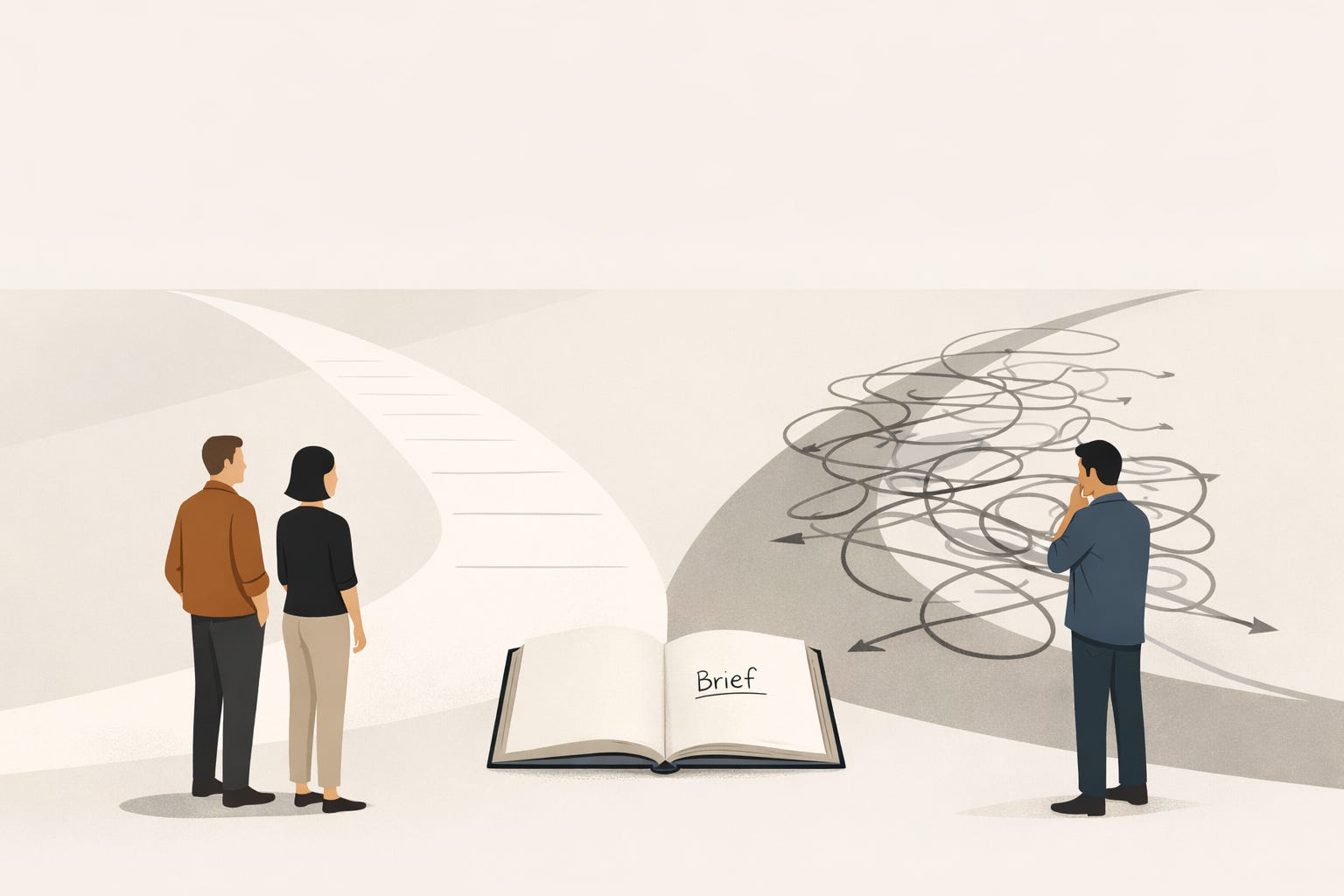
So teams jump straight into execution. Often with a document that looks complete, sounds confident, and is quietly full of holes.
Halfway through production, it happens.
Someone asks a “small” question.
A stakeholder reacts oddly.
The work feels… off.
And that’s when you realize the worst thing possible:
you’re solving the wrong problem.
Now you’re three steps in, with sunk time, bruised trust, and creative energy already spent, walking backward to a conversation that should have happened at the start.
I’ve lived this more times than I care to admit.
And it’s one of the most expensive patterns in modern creative work.
The Rush to Create (and the Work We Skip)
Most teams don’t skip briefing because they’re careless.
They skip it because:
Speed is rewarded
Output is visible
Thinking is invisible
Doing the quiet, unglamorous work of alignment doesn’t feel like progress.
It feels like delay.
In martial arts, there’s a word for this kind of preparation—the dojo work.
The drills, the stance, the fundamentals you don’t see in the fight.
Skip it, and the cost doesn’t disappear.
It just shows up later, under pressure.
Creative work is no different.
When teams rush past the brief, they’re not saving time.
They’re deferring thinking and pushing it downstream, where it’s far more expensive to fix.
Why Most Briefs Fail (Even When Everyone Is Smart)
Here’s the uncomfortable truth:
Most creative briefs don’t fail because people are lazy or untalented.
They fail because they’re trying to do too many things at once.
Common patterns I see across companies, agencies, and founders:
Context overload, decision drought
Lots of background. Very few clear calls.Inputs masquerading as strategy
“Here’s what we like” instead of “Here’s what we’re choosing.”Vibes instead of constraints
Aspirational language with no teeth.Hidden contradictions
“Bold but safe.”
“Premium but mass.”
Everyone senses the tension. No one names it.
On paper, the brief looks fine.
In reality, it’s a liability document.
It passes ambiguity forward and asks creative teams to resolve it under deadline—through taste, guesswork, and iteration.
That’s not collaboration.
That’s outsourcing decisions.
The Reframe: A Brief Is a Decision Document
A useful creative brief isn’t a form.
It’s a set of committed decisions.
It answers questions like:
What problem are we actually solving?
Who are we choosing to ignore?
What tradeoffs are we willing to accept?
What does success look like this time?
When those decisions are made upstream, creative work accelerates.
When they’re not, creative work becomes a negotiation.
This is where many teams get stuck:
They think briefs are about alignment.
In reality, briefs are about commitment.
Alignment is the outcome.
Decision-making is the work.
The Operator’s Pain Point No One Talks About
If you’ve led creative teams long enough, you know this feeling:
You’re not frustrated because the work is bad.
You’re frustrated because it could have been great—if only the brief had been clearer.
The real cost isn’t revisions.
It’s:
Lost momentum
Eroded trust
Teams feeling like they “missed” without knowing why
And worst of all, the post-mortem always sounds the same:
“We should’ve clarified this earlier.”
Everyone agrees.
Nothing changes.
Why I Built Briefchecker
Briefchecker (it’s 100% free) didn’t start as a product idea.
It started as a repeated pattern across projects, teams, and roles:
Smart people
Good intentions
The same avoidable breakdowns
What bothered me wasn’t that briefs were imperfect.
It was that their weaknesses were predictable.
Missing decisions.
Unresolved tensions.
Contradictions hiding in plain sight.
And yet, catching them depended on experience, seniority, or someone brave enough to slow things down.
That felt wrong.
Good briefing shouldn’t require:
Being the loudest person in the room
Having “great instincts”
Learning the hard way, repeatedly
So the question became:
What if we could pressure-test a brief before creative energy gets spent?
Not to rewrite it.
Not to generate ideas.
But to surface what’s unclear—early, calmly, and without ego.
In the end, any creative effort that is produced ( wether video, image, blog post etc…) should be ultimately cross-checked with the original brief to see if it is fulfilling it.
What Briefchecker Actually Does
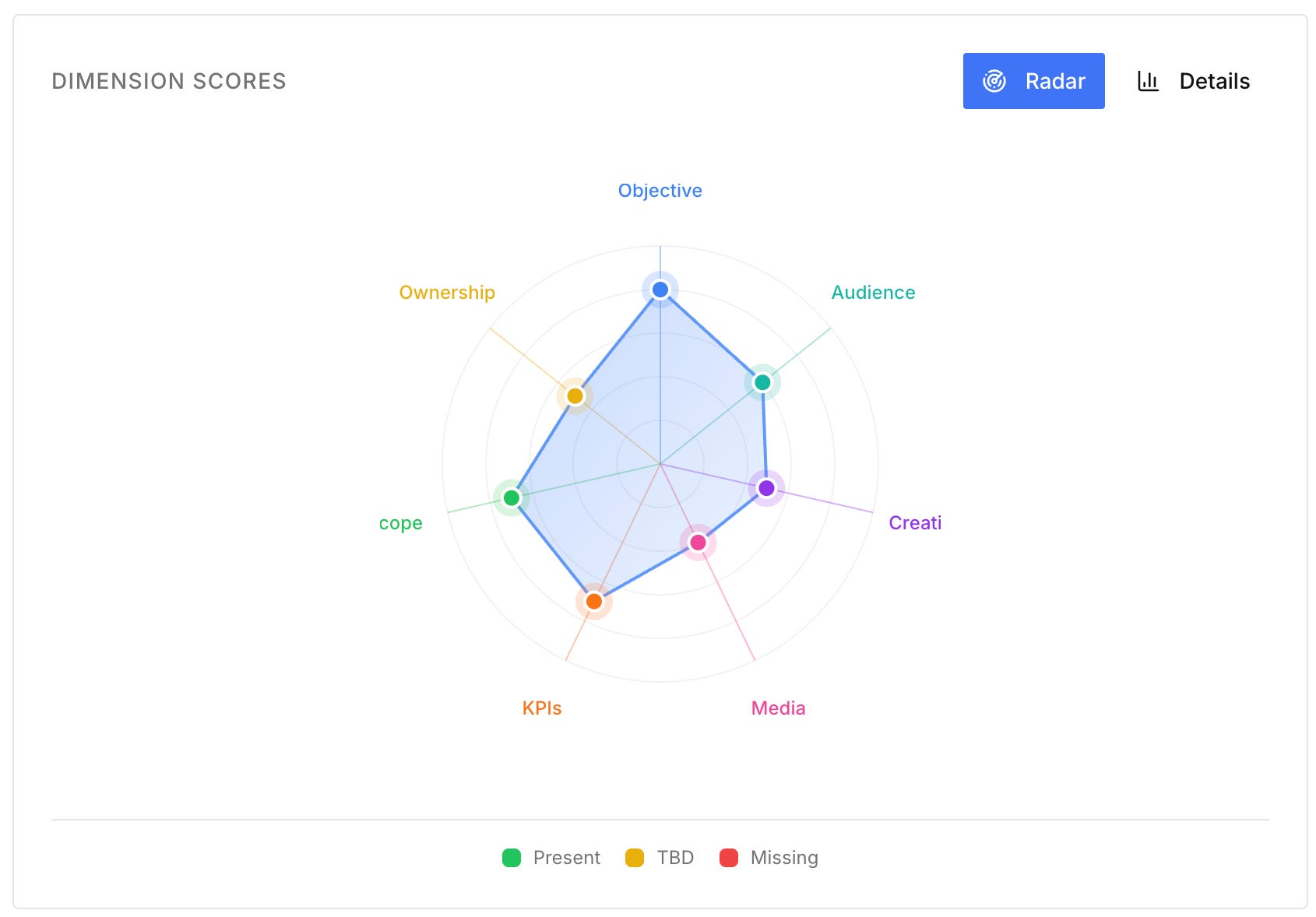
At a high level, Briefchecker acts like a second set of experienced eyes.
You run a brief through it, and it looks for:
Missing strategic decisions
Conflicting signals
Overloaded goals
Vague success criteria
Instead of suggesting “better copy” or “cooler ideas,” it focuses on clarity quality.
The output isn’t inspiration.
It’s friction—in the right place.
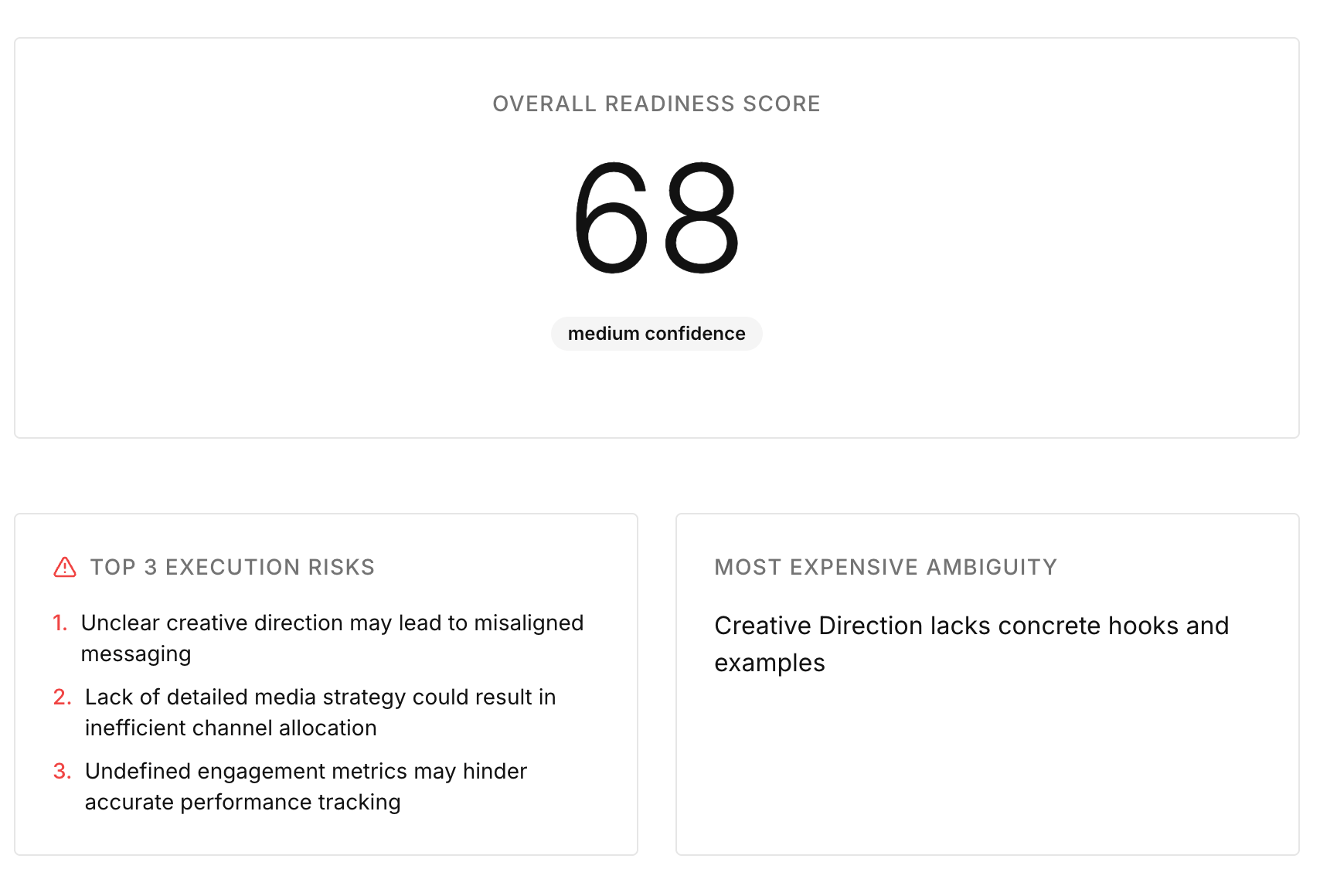
A scoring system forces the brief to earn its confidence.
Not based on polish, but on decisiveness.
It doesn’t tell you what to choose.
It makes it harder to avoid choosing.
That distinction matters.
A Note on How It’s Built (and Why That Matters)
A quick word on the tech—because the choices here are intentional.
Briefchecker is powered by Mistral AI, chosen for control, efficiency, and alignment with how we wanted the system to think—not hype.
There’s no data retention.
Your briefs aren’t stored, or reused. Trust comes before growth tricks.
And the scoring system isn’t there to gamify the process.
It’s there to do one thing: surface discomfort early.
Every technical decision reflects a belief:
This tool shouldn’t replace judgment
It shouldn’t smooth over tension
It should make thinking visible
If the brief passes easily, great.
If it doesn’t, that’s the point.
Who This Is (and Isn’t) For
Briefchecker isn’t for teams looking to “move faster” by thinking less.
It’s not for people who want AI to do the work for them.
It is for:
Creative leaders tired of mid-project course corrections
Operators who care about clean handoffs
Founders who want better output without burning teams
If you believe creative work is a system—not just a spark—this will feel familiar.
One Simple Invitation
If this post sounds uncomfortably familiar, try this:
Take one real brief you’re about to send into production.
Run it through Briefchecker.
Not to validate it.
Not to perfect it.
Just to see what questions surface before you spend creative energy.
Because fixing a brief at the start doesn’t slow teams down.
It’s how you stop walking backward halfway through the work.
Thanks for reading,
Fabien.

