The Water Ring: Flow Without Drift
Adapt without abandoning who you are.


Build your foundation. Sharpen your systems. Execute with precision. Brand Runner brings you creative productivity frameworks and brand strategy insights rooted in timeless principles. Subscribe for the dojo work nobody sees but everyone feels.
Hi,
Two weeks ago, we explored the Earth Ring, the foundational systems that make everything else possible. Today, we’re diving into Water, the ring that determines whether your strategy survives contact with reality.
Water is this: knowing when your plan should bend and when it should break.
It’s 9am. You’re in the office kitchen making coffee when your phone lights up. The platform you’ve been betting on just announced a major algorithm change. The format you’ve spent three months perfecting? Dead in the water.
Your Q3 roadmap is locked. Creative approved. Budget allocated. Timeline set. Everyone’s expecting you to execute the plan.
But the plan just became obsolete.
You have two choices: pretend nothing changed and execute anyway, or adapt.
Most marketers freeze. Some panic and start over. The best ones flow.
This is the Water Ring. Not about abandoning strategy, but about knowing which parts bend and which parts hold.
What Musashi Actually Said About Water
Miyamoto Musashi’s Water Book isn’t about going with the flow. It’s about becoming the flow.
His teaching: “The spirit of water takes any form. Water crashes from a height with force, covers any distance, becomes a trickle, becomes the ocean.”
Water adapts to terrain without losing its nature. Bruce Lee famously said Pour it in a cup, it becomes the cup. Pour it in a bottle, it becomes the bottle. But it never stops being water.
For marketers: “Make your fighting stance your everyday stance, your everyday stance your fighting stance.”
Your strategy shouldn’t have two modes—”the plan” and “panic mode.” It should flex naturally between execution states without losing center.
Think about the last time you had to pivot mid-campaign. Did it feel strategic or desperate? Fluid or chaotic?
That’s the difference Water makes.
The Real Problem: We’ve Built Rigidity Into Everything
We build quarterly roadmaps like they’re sacred texts. Lock creative in review cycles that take weeks. Set timelines that assume nothing will change between approval and execution.
Then reality hits.
A competitor launches something you didn’t see coming. A cultural moment makes your messaging feel tone-deaf. The platform deprioritizes your best-performing format.
And you’re stuck. Not because you lack ideas, but because your infrastructure wasn’t built to bend.
I’ve watched brilliant marketers lose opportunities because they couldn’t move fast enough. Not because they weren’t smart or strategic, but because adaptation wasn’t designed into their process.
The rigid marketer says: “We planned this in January. We’re executing it in June.”
The Water marketer asks: “What’s changed since January that should change how we execute?”
Notice: not whether we execute. Not what we execute. How.
Your positioning doesn’t change because Instagram prioritizes Reels. Your brand voice doesn’t shift because LinkedIn rewards carousels. Your strategic direction doesn’t pivot because TikTok launches a feature.
What changes is how you express those constants.
That’s the first principle of Water: your core is fixed, your execution is fluid.
Platform Changes, Principles Don’t
Think about how you talk to different people in your life.
You speak differently to your CEO than to your best friend. Different vocabulary. Different energy. Different references. But you’re still you. Same values. Same perspective. Same personality.
That’s not code-switching. It’s translation.
Water marketing works the same way. Your positioning stays constant. Your expression adapts to terrain.
What This Actually Looks Like:
Let’s say your brand positioning is: “Marketing grounded in timeless principles, not fleeting tactics.”
LinkedIn: Strategic, case-study driven. “Here’s why foundational systems compound over time.”
Threads: Conversational, insight-forward. “Most marketers optimize for motion. The best ones optimize for momentum.”
Substack: Narrative, philosophical. “Musashi’s Water Book teaches flexibility in execution, not abandonment of strategy.”
Same strategic truth. Different terrain.
Water flows through all three without becoming something else.
The Infrastructure That Makes This Possible:
You can’t adapt fluidly if every piece of content starts from zero.
This is where Water meets Earth. Your modular content system, the one you built in the Earth Ring, becomes the foundation for fluid execution.

Example from my own workflow:
My content lives in a modular system. Each insight is tagged by Ring, by platform, by format.
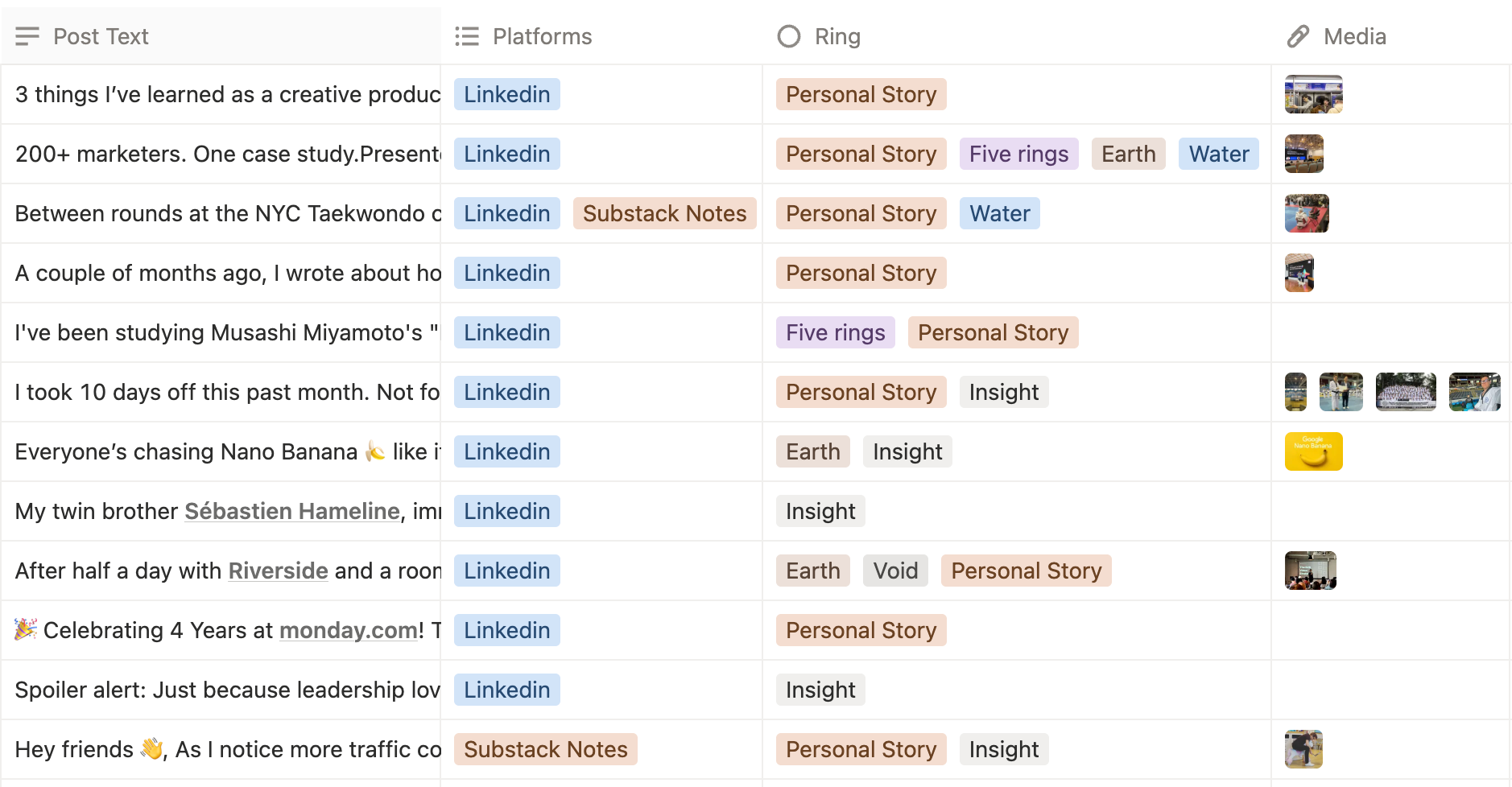
When I need to adapt, I’m not starting from scratch. I’m remixing from a library of strategic pieces. They might resonate differently
One Substack essay becomes:
5 LinkedIn posts (different angles, native format)
10 Threads posts (punchy, conversational)
15 quote cards for Instagram (visual, minimal text)
1 email sequence (narrative, deeper engagement)
One piece of strategic thinking. Multiple expressions.
That’s Water enabled by Earth. Build once, flow forever.
Prepare Your Plays Before the Moment
You’re sitting in a conference room. Someone just said: “We need to respond to this trend. Can we have something by end of day?”
If your answer involves panic, scrambling, and “let me see what I can throw together,” you don’t have Water. You have chaos.
Water isn’t reactive. It’s prepared.
Here’s what changed for me: I stopped trying to be faster at creating and started being ready before the moment hit.
Last month, I presented a video case study to 200+ marketers at a monday.com event.
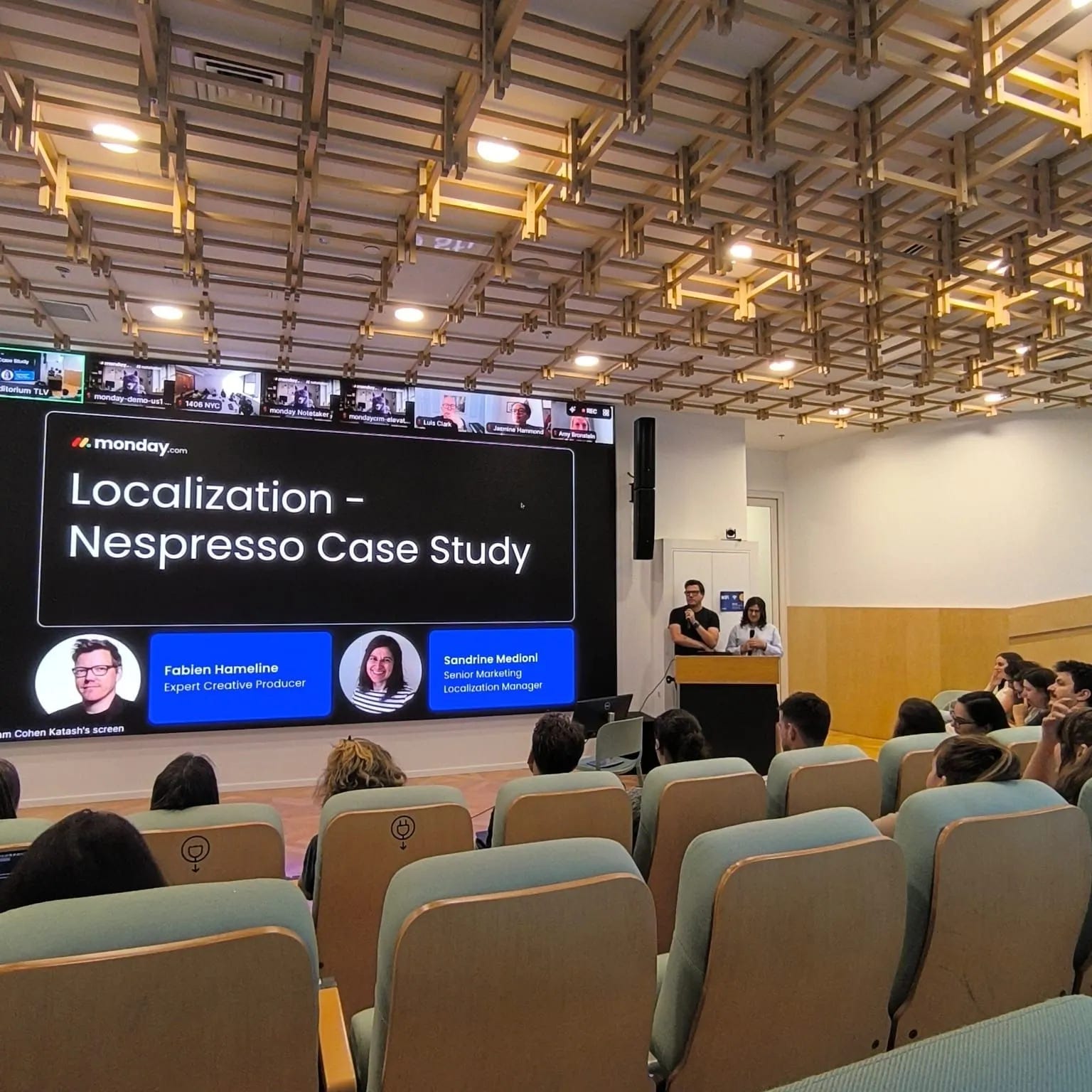
The video we screened was produced in record time—not because we rushed, but because we had:
A distilled production process (Earth: systems create speed)
A trusted partner who knows our rhythm (Water: flow with the right people)
Pre-built creative frameworks we could adapt to the brief (Water: prepared plays)
No panic. No all-nighters. Just clarity under pressure.
This is what Musashi meant by preparation. He didn’t improvise in duels. He drilled technique endlessly so that when the moment came, his body moved before his mind decided.
Marketing works the same way. The brands that move fastest when opportunities hit aren’t winging it. They’ve built the infrastructure that makes speed possible.
What “Prepared Plays” Actually Means:
Not campaign decks sitting in a drawer. That’s rigidity disguised as readiness.
Real preparation is modular systems that let you deploy when timing matters:
1. Brief templates that answer strategy upfront
When a moment hits, you don’t have time to figure out positioning. Your brief template already answers: What’s the strategic goal? Who’s this for? What’s the one thing they should remember?
Fill in context, not strategy.
2. Content components ready to recombine
Your brand story. Your proof points. Your visual system. Your voice guidelines.
These don’t change week-to-week. Build them once (Earth). Remix them when timing matters (Water).
3. Decision frameworks that eliminate debate
“Do we move on this or not?” shouldn’t be a two-hour meeting.
Your framework answers it in five minutes.
When moments matter, process trumps panic.
Find the Right Window, Not the Loudest Crowd
Here’s where most “be agile” advice falls apart: people think adaptation means chasing everything.
It doesn’t.
Water’s real discipline is knowing which moments are yours and which ones to let pass.
Not every platform shift requires your response. Not every viral moment is your moment. Not every trend deserves your energy.
The Three Questions That Define Your Window:
1. Does this moment amplify our positioning, or dilute it?
A trend might be massive, but if engaging with it pulls you off-message, it’s not your window.
Example: Everyone’s doing “10 tips” listicles because they perform well. But if your positioning is “depth over speed, principles over tactics,” you don’t chase that format just because it’s loud.
You find the window where your message and the moment align.
2. Can we execute this authentically, or are we performing?
If you have to fake fluency with a trend to participate, you’ve already lost.
Water adaptation means bringing your perspective to the moment, not mimicking what others are doing.
Real talk: I see brands jump on viral formats they clearly don’t understand, and it shows. The audience can feel the performance. They scroll past.
The brands that win aren’t the ones who copy the format. They’re the ones who remix it through their lens, in their voice, with their point of view.
3. Is this a moment or a movement?
Moments pass. Movements compound.
Water marketers know the difference. They don’t burn energy on fleeting trends. They invest in shifts that have legs.
Example: Short-form video isn’t a moment. It’s a movement. Adapting your content strategy to include it makes sense.
A dance trend on TikTok? Probably a moment. Chase it only if it’s authentically your terrain.
Here’s the skill: strategic selectivity.
The brands that feel effortless aren’t moving constantly. They’re moving precisely.
The Discipline of Water
Fowing requires more discipline than rigidity.
Rigid execution is easy. You made the plan. You follow the plan. No calibration required.
Water execution is constant judgment. Knowing when to move and when to hold. Recognizing which moments are yours. Deploying prepared plays without hesitation.
The discipline of Water is this: stay loose in execution, stay firm in strategy.
Musashi never changed his fighting principles. He adapted his technique to every opponent. Same strategic core. Fluid tactical expression.
Without Earth, Water becomes reactive chaos. Without Water, Earth becomes rigid irrelevance.
You need both.
Building Your Water Ring: Where to Start
You don’t need to overhaul everything. Start with one adaptive system and let the benefits compound.
Step 1: Build Your Modular Content Library
Stop creating one-off posts. Start building reusable components:
10 core insights that define your positioning (written once, expressed many ways)
Platform translation templates (how each insight adapts to LinkedIn, Threads, Instagram)
Format variations (text post, carousel, video script, thread structure)
When you need to move fast, you’re remixing, not rebuilding.
Step 2: Define Your Decision Framework
Write down the criteria that determine when you adapt:
What shifts require a response? (Format evolution, platform changes that affect your distribution)
What shifts do you ignore? (Fleeting trends, competitor panic, noise disguised as signal)
Who decides, and how fast can you move?
Clarity in advance creates speed in the moment.
Step 3: Prepare Three Plays
Identify three scenarios where speed matters and build the infrastructure now:
Play 1: Cultural moment aligns with your positioning (brief template, approval path, content ready)
Play 2: Platform format shift (modular content ready to adapt)
Play 3: Competitive move creates opening (positioning response, messaging framework, distribution plan)
You won’t use these every week. But when the moment hits, you’ll move while others are still scheduling the meeting.
What’s Next
Water is the second ring. It builds on Earth and sets up Fire.
Earth gave you the foundation. Water gives you execution flexibility. Fire, which we’ll explore next, gives you the force to strike when the window opens.
The Five Rings aren’t steps. They’re simultaneous layers. You’re always operating in all five at once.
Next up: Fire Ring—how to strike with creative force when the moment is right.
Your move:
What’s one prepared play you need to build before the next opportunity hits? What’s one moment you chased that wasn’t actually your window?
Reply and tell me. That’s your Water work.
— Fabien
P.S. — Share this with someone who’s stuck between “stick to the plan” and “wing it.” Water is the third option.
Other articles you might be interested in


Unlock Timeless Strategy for Modern Brands
What can a 17th-century swordsman teach you about content strategy, brand building, and growth?
Turns out — a lot.
The Five Rings of Marketing is a bold, battle-tested guide to mastering modern marketing with ancient wisdom.